

A 3PL Receiving Brief for Multi-Carton Sofa Sets
Connect each sellable set to its modules, cartons and warehouse SKUs before the first inbound delivery, then prove the setup with one simulated outbound order.

A retailer may sell one compressed modular sofa while a 3PL physically receives several cartons. The warehouse cannot reconstruct that relationship from carton labels alone. Before the first inbound delivery, the retailer, supplier and 3PL need one approved map that connects the sellable set, its component modules, every expected carton and the warehouse item records used to receive and pick them.
The practical release package is a receiving brief: approved set-to-carton data, the inbound ASN or receiving order, the identifier and label rules, exception ownership and one simulated outbound order. A carton can be received individually without becoming independently sellable. The sellable set is complete only when the required components for the approved configuration are available under the warehouse rules.
What should a 3PL know before receiving multi-carton sofa sets?
Start with the business relationship, not the label design. State which product the customer buys, how many physical cartons the approved configuration normally uses, whether any carton contains more than one module, and whether modules are shared across other sellable sets. Include the effective model revision so an old carton plan is not used for a changed configuration.
Name the warehouse action for each level. The 3PL may receive and store cartons as separate logistics units, but it must know whether inventory is controlled by carton SKU, module SKU or both. It must also know which combination is required before a complete sellable set can be allocated to an order.
Give the 3PL an owner for data questions and an owner for physical exceptions. Receiving should not guess whether an unfamiliar carton replaces another carton, belongs to a new revision or is extra stock. A pending status keeps the carton identifiable while the retailer or supplier resolves the discrepancy.
How should a sofa set, module, carton and warehouse SKU be mapped?
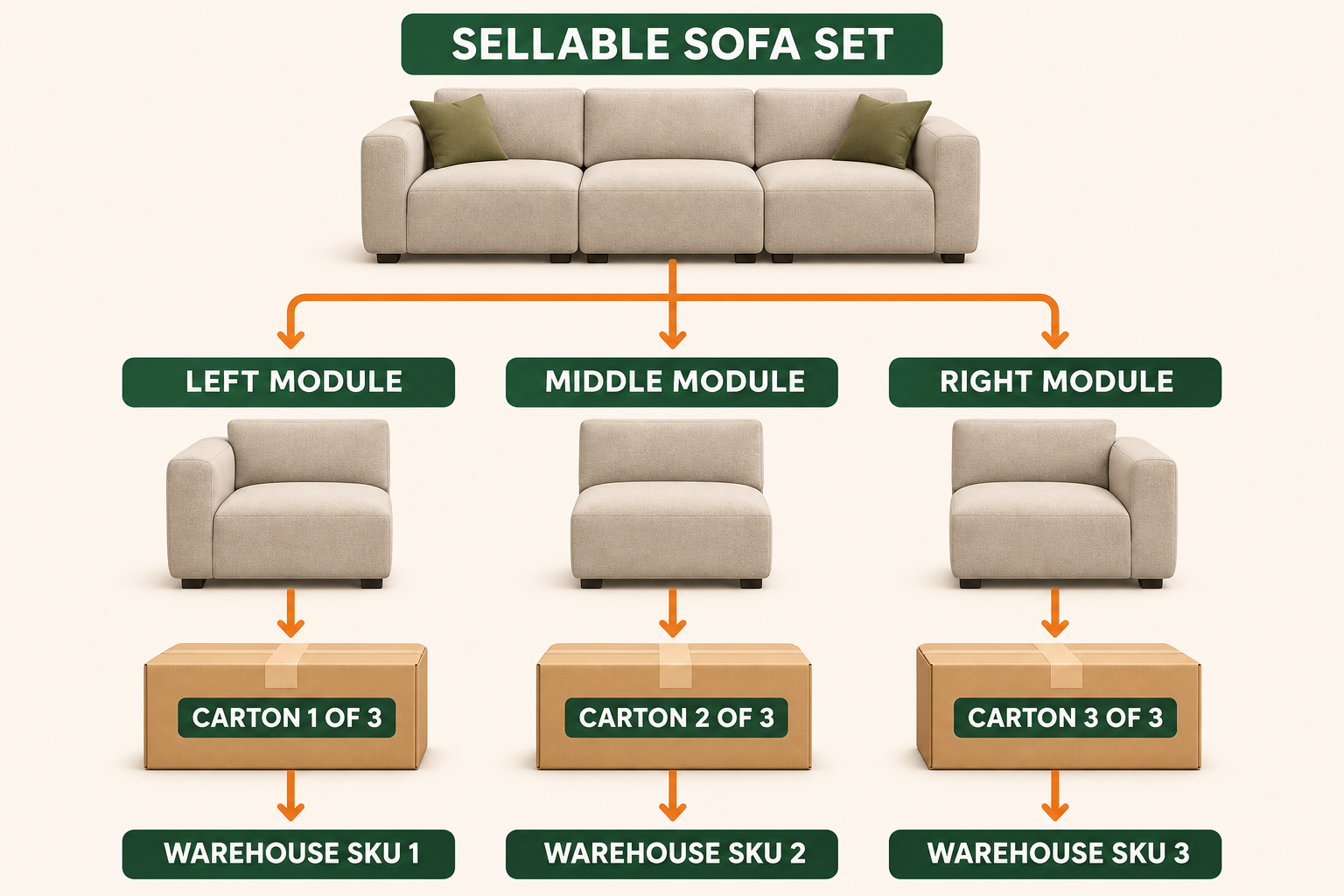
Use four linked levels: sellable set, component or module, physical carton and warehouse identifier. A set SKU describes what is sold. Component records describe what must be present. Carton records describe what arrives. Warehouse SKUs or license-plate identifiers tell the 3PL what to receive, locate and pick.
Give every row a stable key and revision. At minimum, record the sellable set, required component, carton sequence, expected quantity, warehouse SKU, supplier carton code and the label identifier used at receipt. If one carton contains several components, list each component against the same carton identity instead of inventing separate cartons.
Keep compatibility explicit. A module used by two sets can share stock only when the released specification, cover, direction, connector, packaging and revision are the same. Similar appearance is not evidence of interchangeability. Mark unverified relationships as pending and incompatible relationships as blocked.
| Sellable set | Required component | Physical carton | Warehouse SKU | Qty / status |
|---|---|---|---|---|
| SET-3S-A | Left seat module | Carton 1 of 3 | WH-LS-A | 1 / released |
| SET-3S-A | Middle seat module | Carton 2 of 3 | WH-MS-A | 1 / released |
| SET-3S-A | Right seat module | Carton 3 of 3 | WH-RS-A | 1 / released |
Illustrative only. Replace every code, quantity and carton relationship with the released model and 3PL master data.
Should the warehouse receive the complete sofa or each carton separately?
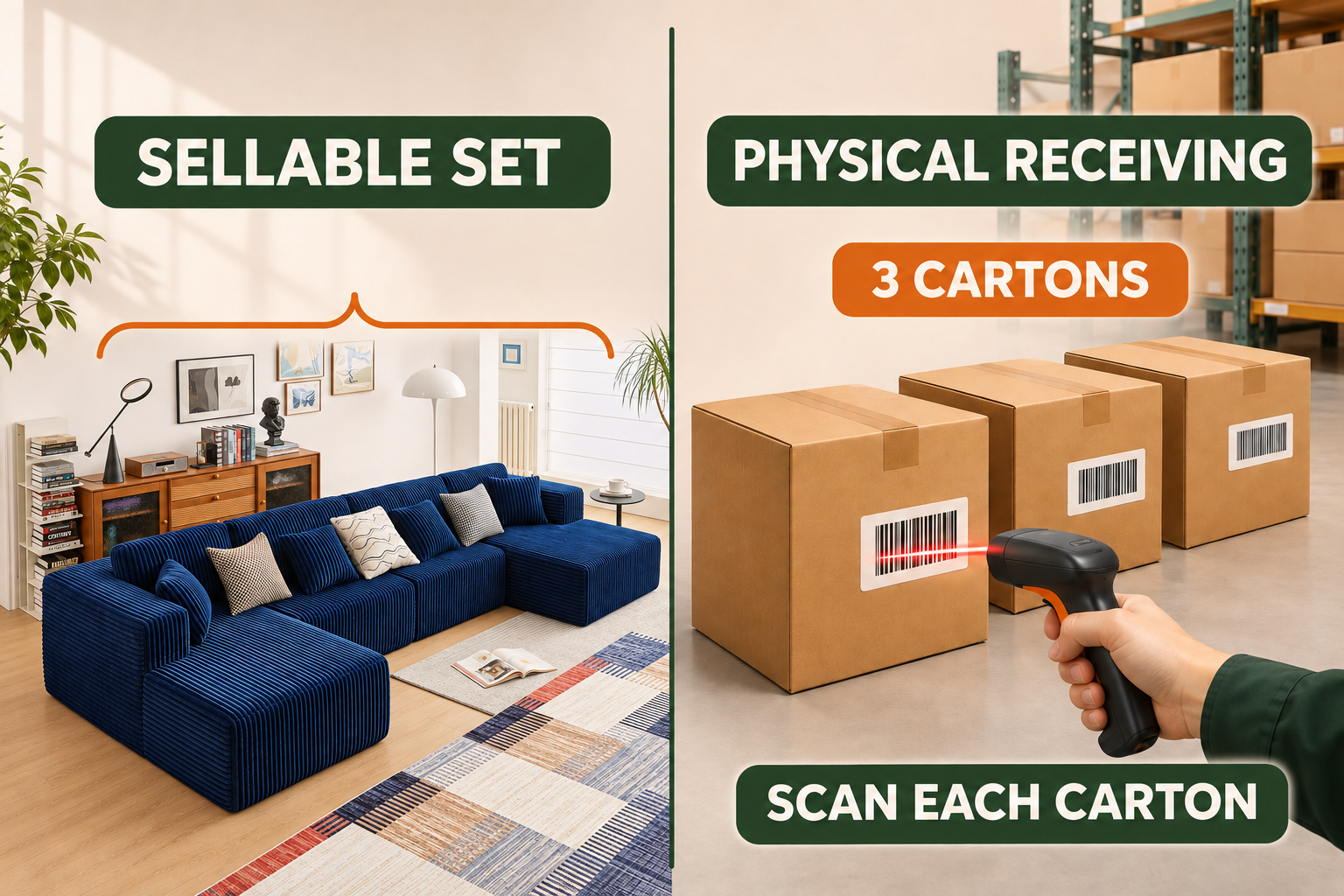
Receive the physical unit that actually crosses the dock: each carton or pallet receives its own transaction and identifier. Then preserve the parent relationship to the inbound shipment and the sellable sofa set. This makes a short carton, damaged carton or late carton visible without pretending the complete set arrived.
Do not increase complete-set availability merely because one carton was received. Availability should follow the required component quantities for the released configuration. If the warehouse system supports kits or bundles, configure the set as a non-stocked parent with component inventory, or use an equivalent controlled rule validated by the 3PL.
The exact implementation depends on the warehouse system. Some 3PLs use component SKUs, some use carton SKUs and some add license-plate numbers to cartons or pallets. Approve the actual method in writing and test it; do not copy a generic system screenshot into the operating procedure.
What should an inbound ASN or receiving order include?
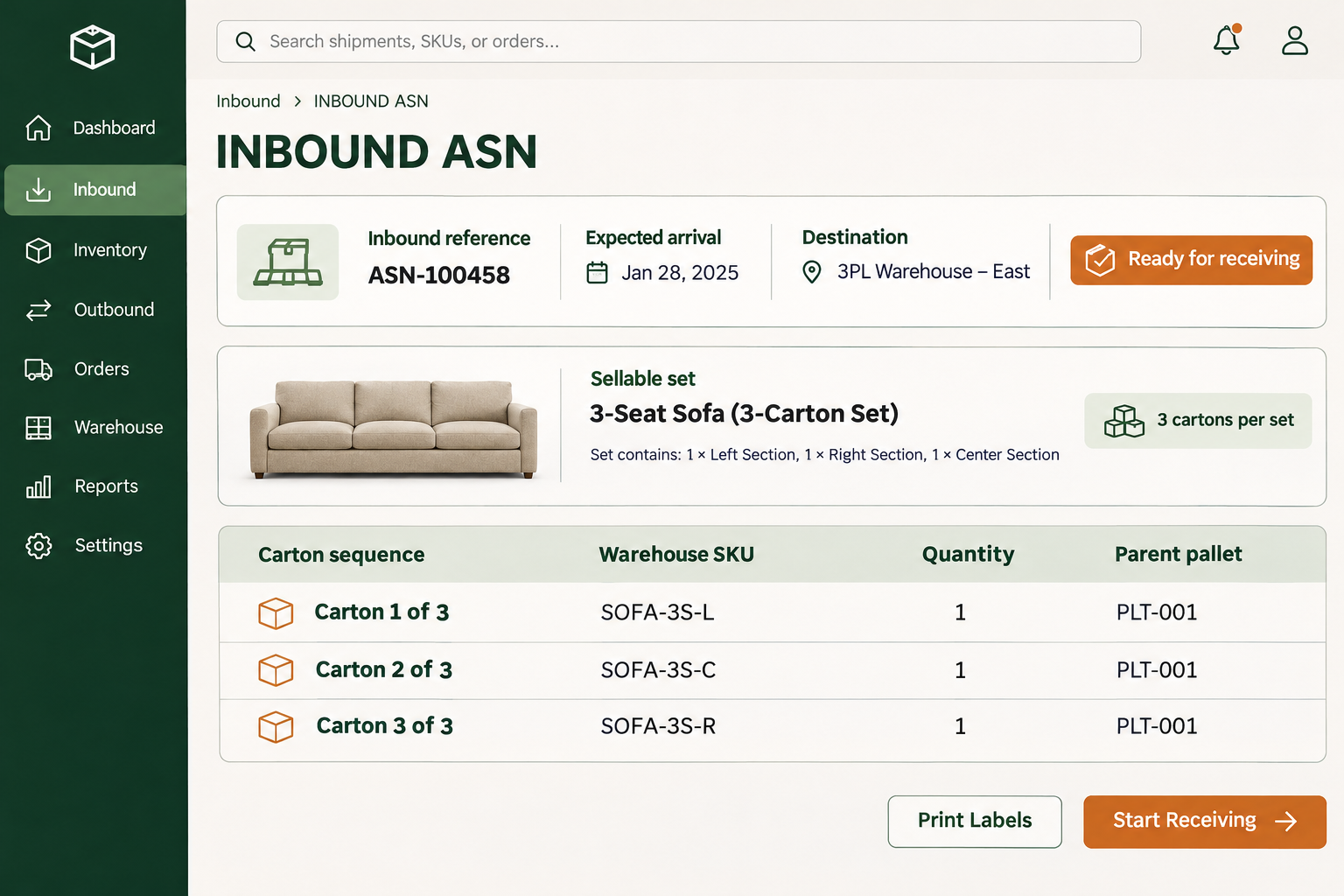
The inbound record should identify the supplier, purchase or transfer reference, expected arrival window, destination, sellable configuration, expected cartons, component quantities and packaging hierarchy. Use the 3PL's accepted fields and code values rather than sending a separate spreadsheet that cannot be imported or reconciled.
List each expected logistics unit or carton with its sequence, warehouse SKU, quantity and identifier. If the supplier sends pallet-level data, keep the parent pallet relationship and the child carton detail needed for receiving. A total such as '30 sofa sets' is not enough when the dock must account for 90 physical cartons.
Freeze the receiving order after label creation unless the 3PL accepts an approved change. If quantities, carton count or identifiers change, issue a revision before arrival and preserve the old reference for audit. The ASN, packing list and physical labels should describe the same shipment.
Inbound data check
Reconcile four views before arrival: purchase or transfer reference, ASN/WRO, supplier packing list and physical carton labels. They should describe the same quantities and packaging hierarchy.
How should carton labels support 3PL receiving?

Every independently handled logistics unit needs a unique scannable identity under the chosen warehouse and channel rules. The human-readable part should also show enough information for exception handling: supplier, warehouse SKU or carton code, carton sequence, quantity and the related inbound reference where the 3PL requires it.
Place labels where they remain flat, visible and scannable after handling. Remove or cover obsolete logistics labels and barcodes so a scanner does not select an old identity. Do not print an SSCC, retailer barcode or marketplace label unless the identifier has been correctly allocated and the receiving system is configured to use it.
Send a label sample and scan test before mass production. The test should verify barcode content, symbology, print contrast, placement and the data returned in the 3PL system. A label that looks correct in a PDF can still fail because the encoded value or warehouse master data is wrong.
How should the 3PL handle short, excess or unidentified cartons?
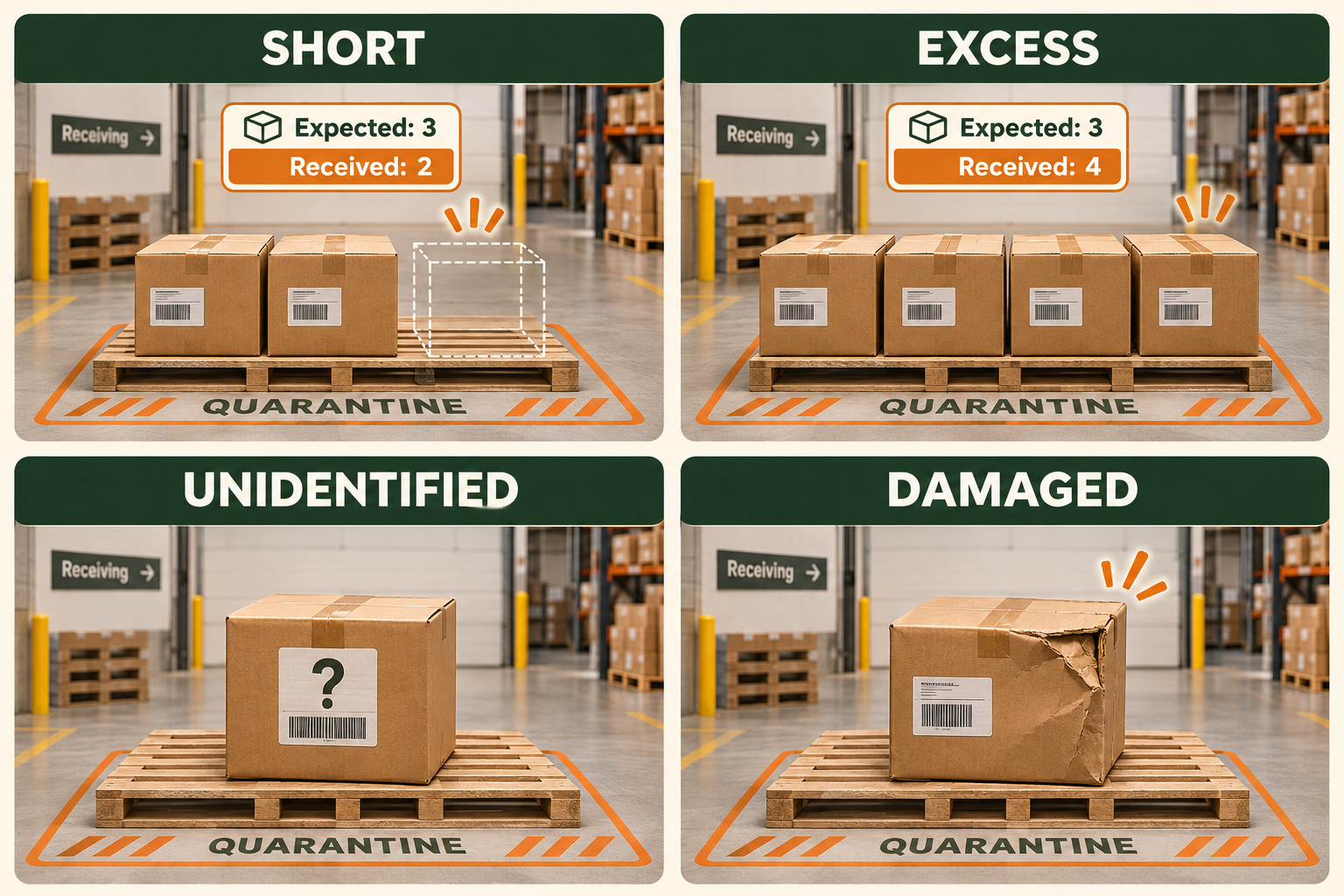
Define exception statuses before the truck arrives. Short means the physical count is below the approved inbound record. Excess means more units arrived than expected. Unidentified means the carton is present but its code, label or configuration cannot be matched safely. Damaged and mixed-revision cartons should remain separate conditions.
Quarantine only the affected logistics units when safe and practical. Record the inbound reference, carton identifier, photographs, count, condition and scan result. Do not substitute a similar carton, relabel it or add it to available stock until the named owner approves the action.
Use one reconciliation record shared by the 3PL, retailer and supplier. It should show the current status, owner, evidence, required decision and next update time. This prevents the warehouse from correcting stock while the retailer opens a duplicate claim against the same carton.
| Issue | Receiving action | Evidence | Owner |
|---|---|---|---|
| Short | Receive actual count; hold set completion | Count, IDs and dock evidence | 3PL + retailer operations |
| Excess | Hold excess from available stock | Count, IDs and inbound reference | Retailer operations |
| Unidentified | Quarantine affected carton | Photos, label and scan result | Supplier / master-data owner |
| Damaged | Record condition and segregate | Photos, quantity and disposition | 3PL claims owner |
How do you test a sofa set with a simulated outbound order?
After the first receiving test, create one controlled outbound order for an approved sofa configuration. Allocate the sellable set and confirm that the warehouse selects the complete required component group, not just one available carton or a mixture of incompatible revisions.
Pick and stage the cartons in the order the 3PL normally uses. Verify carton sequence, quantities, labels, shipping records and any parent-child shipment relationship. Then cancel or complete the test according to the 3PL's agreed process so test stock does not remain reserved or become customer-facing inventory.
Record evidence: screenshots or reports showing allocation, the physical carton scan results, the final carton count and the inventory balance after the test. A successful test proves only the configuration and revision tested; repeat it when the module map, packaging, label logic or warehouse workflow changes materially.


| Test | Expected result | Evidence |
|---|---|---|
| Allocate set | All required compatible modules reserve once | Allocation report |
| Pick cartons | Correct carton sequences and quantities scan | Pick/scan record |
| Create shipment | Every carton identity reaches the shipment record | Shipment detail |
| Reconcile stock | No test reservation or false set remains | Inventory balance |
What should the final 3PL receiving sign-off include?
The sign-off should name the released configuration revision, the approved set-to-carton map, inbound document format, label version, receiving status rules, exception owners and the completed outbound test. Add the effective date and systems covered so the brief is not treated as a timeless general instruction.
Confirm who maintains each master record after launch. Product or sourcing owns the physical configuration; operations owns the warehouse mapping; the 3PL owns receiving execution and scan evidence; customer service needs a readable carton map for order questions. Assign one change owner to coordinate revisions across those records.
Review the first live receipts and first live outbound orders. Compare expected and actual carton counts, unidentified scans, damages, receiving time and incomplete-set allocations. Correct the data or procedure before scaling, and keep the findings linked to the released revision rather than overwriting the evidence.
Technical verification references
- GS1 | GS1 Logistic Label Guideline
- GS1 | Compulsory data on a GS1 logistic label
- GS1 | General Specifications
- ShipBob | Receiving Process
- ShipBob | Kitting
- Shopify | Bundles eligibility and considerations
- Shopify | Creating product bundles
- Microsoft Learn | Despatch advice and receiving information
- Amazon Seller Central | Packaging shipments
- Odoo | Kits
Share Your Warehouse Label Specification
Send the approved sofa configuration, carton map, warehouse fields, label rules and receiving destination. Yongform can align the packing and carton data before the first 3PL inbound delivery.
Review carton labelling supportPut it into practice with Yongform