
Sofa Module Connectors: Check Compatibility Across Versions
Check module codes, connecting parts and recovered dimensions before combining an older compressed sofa with a newer seat.

An older compressed sofa and a newly available module can look like a matching set without having an approved connection. Before ordering an extra seat, ask the supplier to confirm the exact old and new module versions, the connecting arrangement and the assembled dimensions. Treat missing information as pending confirmation rather than permission to combine them.
This matters when a retailer adds seats to an existing range, an importer replaces one damaged module, or a project buyer mixes remaining stock with a new production run. Compression describes how the product is packed. It does not, by itself, establish whether separate seats can be joined or whether a later version will fit an earlier one.
Identify both module versions
Start with the unit already in use. Retrieve its order reference, module code, production or batch label, approved drawing and assembly instructions. Ask the supplier which revision those records describe. A collection name, upholstery colour or photograph alone is not enough to identify the connection.
Record the proposed addition separately, including its current module code and drawing revision. Mark left and right from an agreed viewing direction, and show which side of each unit will meet. A centre seat, an end seat and an ottoman should not be treated as interchangeable simply because their upholstery looks similar.
If the old label is missing, send the supplier clear photographs of the complete unit and accessible connection areas, together with the original purchase record. Do not assign a revision from appearance. Ask the supplier to identify what can be confirmed and which details still need measurement or inspection.
Check the connection on both sides
Ask for a connection drawing or annotated photographs of both mating sides. Depending on the model, the arrangement may involve brackets, clips, straps or another specified method; some units may be intended for separate placement. Confirm the actual arrangement before looking for replacement hardware.
For a mechanical connection, compare the mating profiles, part references, mounting positions, orientation and engagement path. Where applicable, record the hole spacing and the mounting surface shown on the approved drawing. Two fittings that look alike from above may still need different clearance or a different installation motion.
Ask the supplier to demonstrate assembly and release. Can the parts engage fully with the modules in their intended position? Is the connection accessible for later separation? Do not drill new holes, force the parts together or substitute a generic fitting as a way to establish compatibility. Any proposed conversion needs a supplier-approved method and a fresh review of the resulting pair.

Compare dimensions after recovery
For the new compressed module, use the supplier’s unpacking and recovery instructions before making the final comparison. Record when it was opened, the conditions requested by the supplier and when measurements were taken. Agree when it is ready for evaluation; there is no universal recovery time in this checklist.
Place both modules on the same suitable, level surface and compare the relevant reference points. Record overall depth, seat level, base or foot position, connector height and the position of the meeting edges. Use the drawing’s reference points so a soft cushion edge is not confused with a structural mounting position.
Inspect the joined seat and back as well as the underside. A connection that engages does not settle whether the seam looks and feels acceptable. Compare front-edge alignment, back contours, the gap between modules and the sitting experience across the join. Record upholstery shade and texture separately, especially when the existing unit has already been used.

Approve the exact pairing
Ask for a trial using the actual older version and the proposed new version, or supplier-held samples identified as those exact revisions. Photograph both labels, the connecting parts before assembly, the completed join and the full layout. A demonstration using two current modules does not answer a question about mixing an old and a new version.
Follow the model’s instructions and agree the review conditions with the supplier. Check ordinary sitting, standing up and leaning as appropriate to the intended use, observing movement, opening of the join and uneven support. Demonstrate separation and reassembly too. These observations support a purchasing review; they do not replace any required product performance testing.
If only one module or an incomplete fitting is available, keep the decision open. A drawing review can identify a mismatch, but an incomplete demonstration should not be recorded as a completed pairing approval. Specify the missing evidence and who will provide it.

Record the compatibility decision
Keep one compatibility record for each proposed pair and layout. Include the old module and revision, new module and revision, connection references, drawing references, recovery and measurement record, trial evidence, decision, approver and date. Add any restrictions, such as an approved joining side or a required replacement kit.
Use three clear outcomes. Compatible means the named pair has the required supplier confirmation and supporting review records. Pending confirmation means an identity, dimension, instruction or trial remains unresolved. Not compatible means a documented mismatch prevents the proposed combination. Apply each outcome only to the pair and conditions recorded.
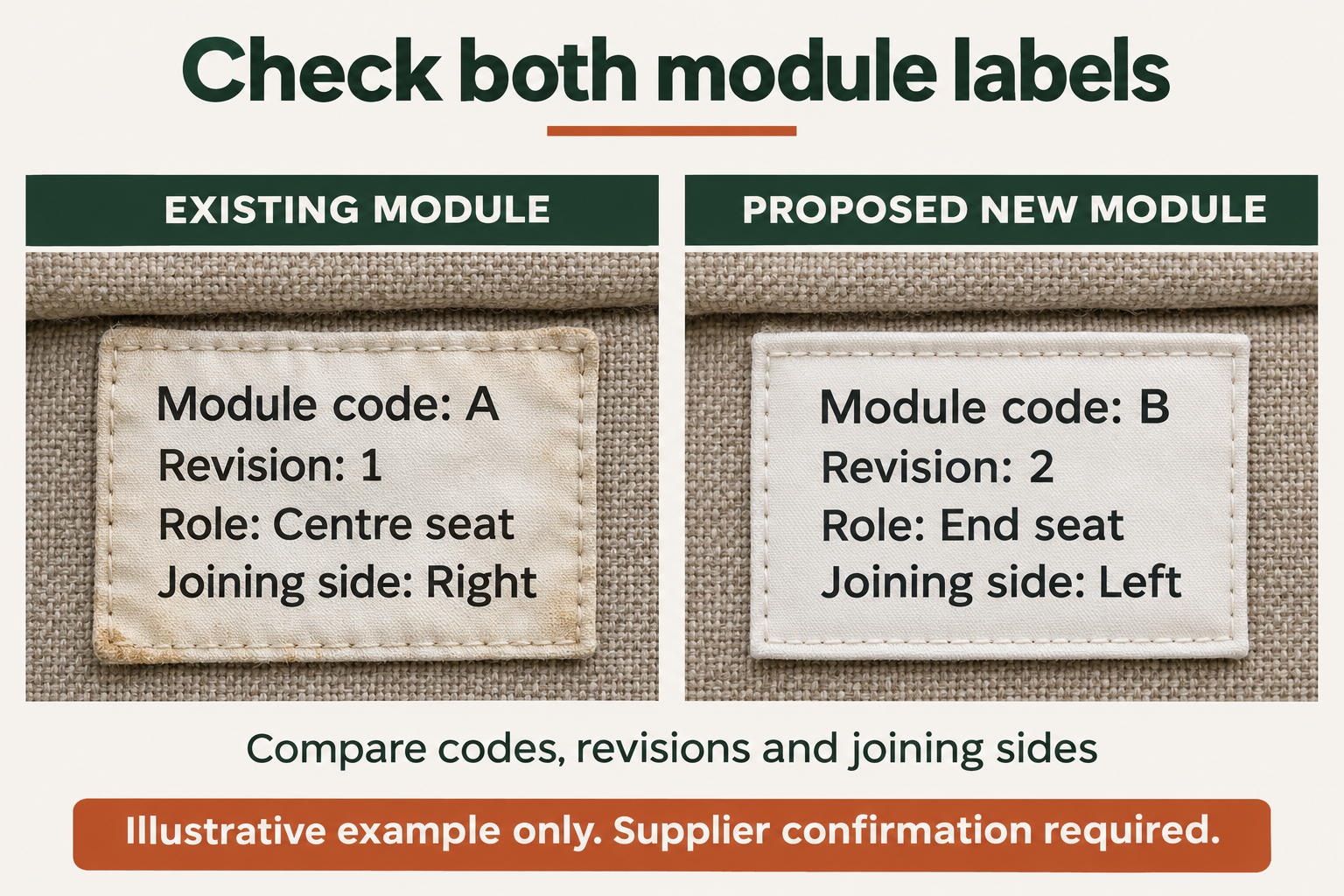
For example, a hypothetical old centre seat labelled A revision 1 and a new end seat labelled B revision 2 remain Pending confirmation if their connector drawings are unavailable. Similar colour and matching advertised width do not change that outcome. These labels illustrate a decision record; they are not Hongkong Yonghua product codes or an actual compatibility result.
Keep replacement orders traceable
Once a pair is approved, put the exact module versions and any required fittings on the replacement order. Link those details to the packing list, carton identification and assembly instructions so the warehouse and installer can follow the same decision. A substitution should return to review before dispatch.
Keep the customer promise equally specific. Say that an additional module is available for a confirmed model and version when that is supported. Avoid promising that any future module in the range will fit. If an older version is discontinued, compare the proposed alternative as a new pairing rather than assuming continuity from the collection name.
Request a Modular Sofa Configuration. Share the existing module label, purchase reference, accessible connector photographs and the layout you want to create. Ask for a version-specific compatibility review before approving an extra compressed sofa module.
Module pairing review record
Complete one record for each proposed old and new module pairing. This is a purchasing worksheet, not a completed product approval.
| Review item | Record or evidence required |
|---|---|
| Existing module | Order reference; module code; batch; revision; joining side |
| Proposed addition | Module code; revision; joining side; intended layout |
| Connection | Part references on both sides; drawing revisions; mounting positions; engagement and release instructions |
| Recovery and dimensions | Supplier guidance; opening and measurement dates; relevant conditions; seat, base and connector reference measurements |
| Pairing trial | Identity of both samples; dated photos or video; assembly, normal-use and reassembly observations |
| Decision | Compatible / Pending confirmation / Not compatible; reason; restrictions; missing evidence |
| Approval and order | Supplier confirmation reference; reviewer; date; required fittings; order and packing-list references |
Request a Modular Sofa Configuration
Share the existing module label, purchase reference, accessible connector photographs and the layout you want to create.
Download the module pairing reviewPut it into practice with Hongkong Yonghua