
Why Do a Sofa Supplier’s Website, Invoice and Factory Show Different Company Names?
Different names usually reflect different roles: selling, producing, exporting, receiving payment and holding certificates. Record which company fills each role and what evidence shows it, and leave legal or credit conclusions to the people qualified to make them.
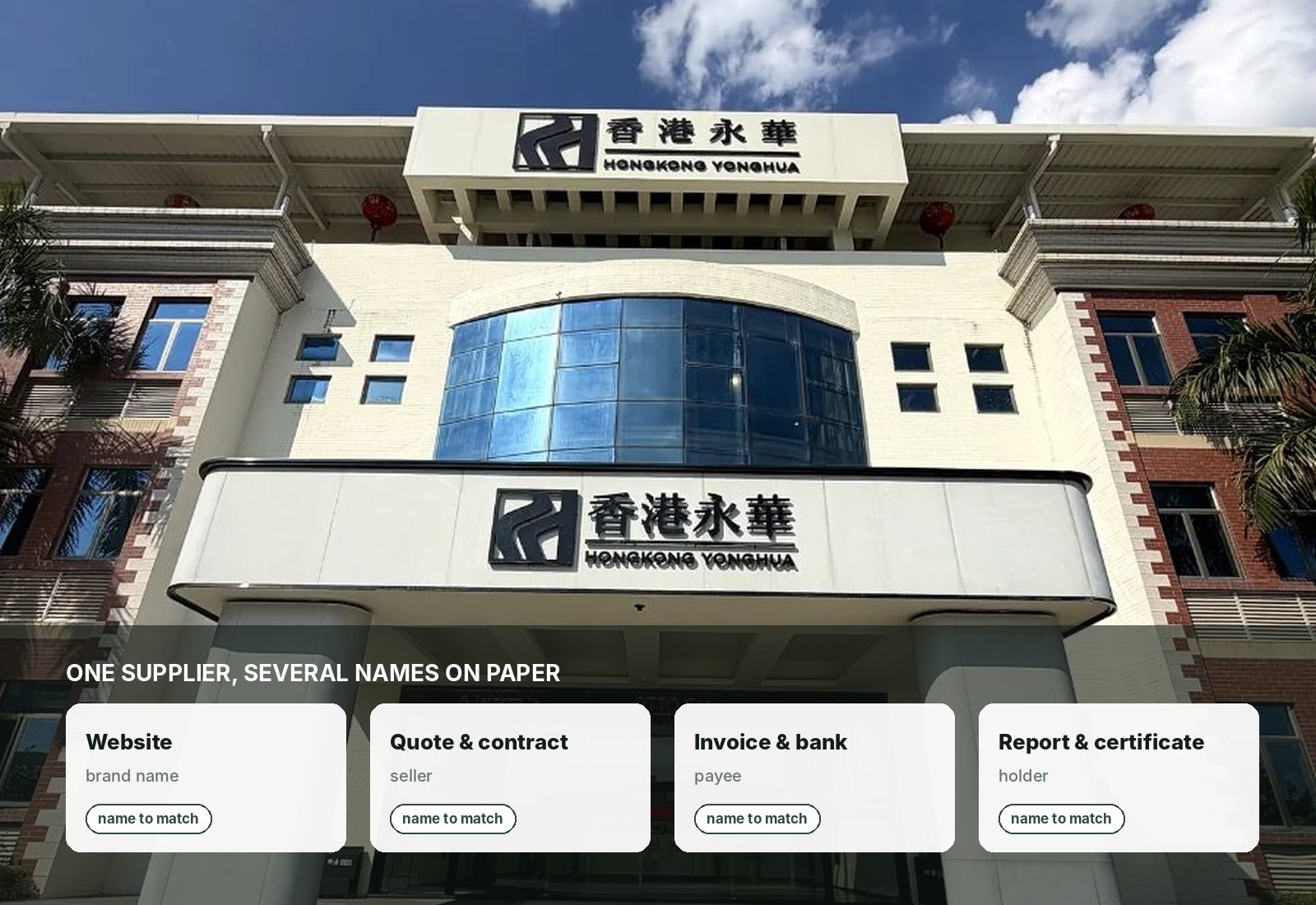


A buyer reviewing a new sofa supplier often finds several company names. The website shows a brand. The quotation comes from a Hong Kong company. The factory sign shows another name, and a test report names a third. It is easy either to ignore this or to assume something is wrong.
Neither reaction helps. This guide shows how to record each name, the role it plays and the evidence for it, so you know which questions remain open. It does not tell you whether a supplier is creditworthy or legally compliant. Those judgements belong to your lawyer, accountant, bank or a third-party verification service.
Why do the names differ?
Manufacturing exporters commonly split their work across companies. One company may sign contracts and receive payment, another may own the factory and make the goods, and a third may hold a material certificate. Customs declarations may name the producer, the seller or an export agent, depending on how the shipment is arranged.

Cross-border tax advisers make the same point: a contract signed by one company, a customs declaration filed by another and payment received by a third can each have a legitimate basis, but only if each company has a real role and the contracts, shipping documents and payments describe the same transaction. A common arrangement described by advisers is a mainland company that produces and a Hong Kong company that signs and collects payment. Different names are a reason to ask questions, not a conclusion.
Field source note. A Xiaohongshu post from a cross-border tax adviser explains that contract, customs and payment entities can differ legitimately if each has a real role and supporting documents. A Zhihu article describes the common mainland-production, Hong Kong-contracting structure. Sources 01 and 02.
Which company does which part of the supply?
Break the supply into five roles and write down the company name that appears for each one.

- Sell and sign: the company on the quotation, PI and sales contract.
- Produce: the factory that cuts the foam, sews the covers and compression-packs the sofas.
- Export: the exporter named on the customs declaration and shipping documents.
- Receive payment: the account name and bank on the payment instructions.
- Hold reports and certificates: the company named on test reports, quality certificates and social audits.
Ask the supplier to fill in the same five roles for your order. A supplier with a clear structure can usually answer in a single email.
Field source note. The same Xiaohongshu tax adviser’s post frames the questions as who sells, who declares for export and who receives payment, and lists the contract, shipping, payment and invoice records that should support each answer. Source 01.
What should an entity verification table record?
Keep one table per supplier. Each row is a company name; the columns record where it appears, the role it plays, the evidence you hold and the question still open.
| Company name and registration no. | Where it appears | Role | Evidence held | Open question | Status |
|---|---|---|---|---|---|
| Company A Ltd (Hong Kong) | Website footer, quotation, contract, bank details | Sell and sign; receive payment | Business registration, contract | Which factory produces our order? | To confirm |
| Company B Co., Ltd (mainland) | Factory sign, audit report | Produce; possibly export | Business licence details, audit report | Who is the exporter on the customs declaration? | To confirm |
| Company C Co., Ltd (mainland) | Material certificate | Hold certificate | Certificate with scope | Does the scope cover our product or only a material? | To confirm |
Record each company’s full legal name and registration number, not the brand or short name. Names that differ by a region or one word can belong to different companies, so match the full name and number across the quotation, the contract, the company seal and the bank details. Where you cannot yet confirm something, mark it “to confirm” rather than filling the gap with an assumption.
Download the entity verification table CSV
Field source note. A Zhihu article on procurement checks recommends recording each counterparty’s full legal name and registration code, matching it across the quote, contract, seal and payment details, and marking unresolved points as pending. Source 04.
How do you start from the supplier’s own disclosures?
Begin with what the supplier publishes. The About page, the footer and any company information page often list registered companies, registration numbers and addresses. Copy every name into your table before you look at any quotation.

Then check each name against the official business registry for its jurisdiction. Buyers who check suppliers commonly look at the business scope, which shows whether a company is registered to manufacture or only to trade, and at the registered address. Where possible, a site visit or live video walk-through confirms that the factory you are shown is the one named.
Finally, compare the disclosed names with the names on the quotation and contract. If a name appears on your documents that the website never mentions, add it to the table and ask what role it plays.
Field source note. A Xiaohongshu post on furniture sourcing recommends checking business licences in the official registry, including business scope and registered address, and confirming production by site or video visit. The procurement article cited above recommends matching full names across documents. Sources 03 and 04.
What should you ask when the payee differs from the contract?
The account name on the payment instructions should normally match the seller on the contract. If it does not, ask why in writing before paying. Ask which company the account belongs to, why that company is receiving payment for this contract, and request a signed instruction or a tripartite agreement that names the payee. Procurement guides advise pausing payment if you are asked to pay a personal account or a company with no stated role in the contract.

Exporters handle the mirror case when a buyer pays through a different company: they ask for a tripartite or payment agreement and keep every record, because the contract, the goods and the money have to describe one transaction. As a buyer, keep the same evidence on your side.
Treat any change of bank details as a separate check. A widely reported fraud in export trade involves an email or chat account being compromised and a “new account” being announced, often with time pressure. Confirm any change by phone using contact details you already hold, not ones supplied in the message, and check the sender’s email address character by character.
Field source note. A Zhihu procurement article advises pausing payment to personal or unrelated accounts and writing payment arrangements into the contract. A Xiaohongshu post from an export accountant describes using tripartite agreements and keeping full records when payer and contract party differ. A Xiaohongshu post describes account-change fraud and recommends phone confirmation through known contacts. Sources 04, 05 and 06.
How do reports and audits fit the picture?
Test reports and certificates have their own name fields, such as applicant or client, manufacturer and inspected party, and they do not mean the same thing. A report requested by a brand for a sample made by a separate factory can legitimately name both. What matters is whether the product, model and materials match what you are buying, and whether the relationship between the companies can be explained. If you doubt a report, verify it through the issuing body’s official channel. Do not accept an edited PDF.

Read the scope and the address too. A certificate covers one company, a stated scope and, for management system certificates, the audited site. Do not assume that a related company’s report or certificate covers your product. Check that the audited address matches the site where your sofas are made.
On a factory visit, ask practical questions that tie the paperwork to the production line: which workshop and line your model runs on, and whether samples and bulk production come from the same place. A sourcing manager writing on Xiaohongshu suggests asking to see the specific line rather than asking whether the supplier is “a real factory”.
Field source note. A Zhihu answer from a testing consultancy explains that report name fields describe different roles and should be checked against the product and the relationship between companies. A Zhihu article from a materials supplier advises asking how a report relates to the product and verifying through the issuing body. A Zhihu article on certification audits notes that the certified address must match the actual site. A Xiaohongshu post recommends asking which line produces the goods. Sources 07, 08, 09 and 10.
What should you check before the first order?
- Every company name on the website, quotation, contract, invoice, bank details, reports and audits is listed with its full legal name and registration number.
- Each name is linked to a role: sell and sign, produce, export, receive payment or hold reports.
- Registration details have been checked in the official registry for each jurisdiction.
- The payee matches the contract seller, or there is a signed explanation or tripartite agreement.
- Bank details were confirmed by phone through a known contact, and any later change will be checked the same way.
- Reports and certificates have been read for holder, scope, model and site, and verified with the issuer where needed.
- Open questions are marked “to confirm” and assigned to someone.
Some questions should go to professionals rather than be settled from the table: whether a payment structure is acceptable to your bank and auditor, whether a contract gives you the protection you need, and whether a company is financially sound. The table gives them the facts to start from.
Discuss an Import Program
Planning to import compressed sofas from China? Ask us to set out which company signs your contract, which factory produces your order, how export is handled and which account receives payment. We will confirm it in writing before your first order.
Discuss an import programPut it into practice with Yongform